
Platform · In development
AEOS: Agentic Enterprise Operating System
The governance layer that lets enterprises put AI agents on real work: every action authorized, every answer evidenced, every step auditable.
A capable model is not a capable organisation. Agent pilots stall on the questions an enterprise already answers for people: who was allowed to ask, what may be touched, who approves, and what happened.
AEOS treats agentic AI as enterprise infrastructure. Agents work under the same identity, authority, policy, approval and audit controls as people, with the same evidence trail. When a model proposes an action, only a deterministic policy decision can authorize it.
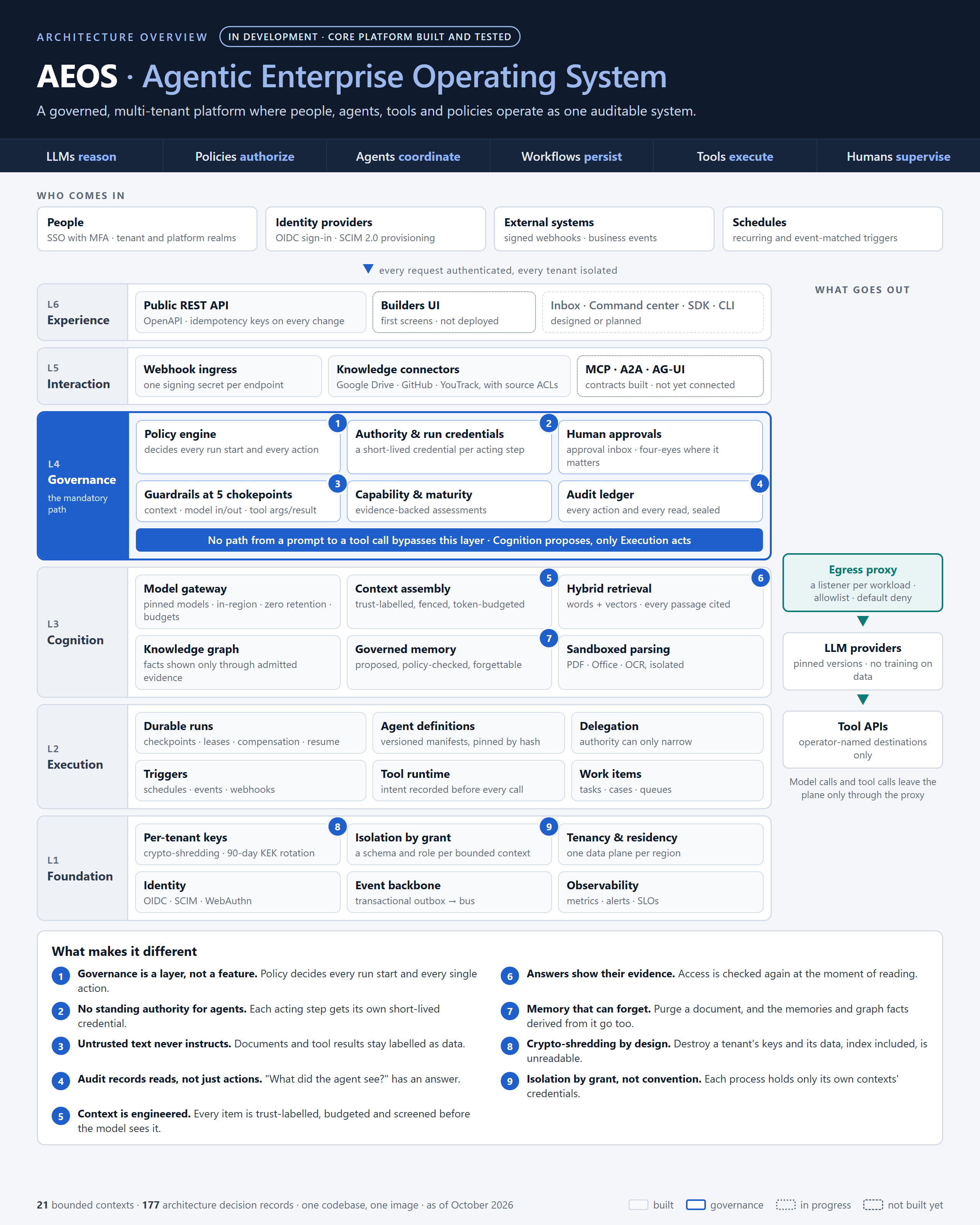
LLMs reason. Policies authorize. Agents coordinate. Workflows persist. Tools execute. Humans supervise.
Architecture
Six layers, with governance on the mandatory path.
Experience
A public REST API, with idempotency keys on every change.
Interaction
Signed webhooks, and knowledge connectors (Google Drive, GitHub, YouTrack) that carry each source's own access rules.
Governance
A policy engine, authority resolution and per-step run credentials, human approvals, guardrail screens, capability maturity, and an audit ledger. No path from a prompt to a tool call bypasses this layer.
Cognition
The model gateway, context assembly, hybrid retrieval with citations, a knowledge graph, governed memory, and sandboxed document parsing.
Execution
Durable runs, versioned agent definitions, delegation, triggers, the tool runtime, and work items.
Foundation
Tenancy and residency, identity, per-tenant encryption keys, an event backbone, and observability.
What makes it different
The decisions that shape it.
Governance is a layer, not a feature
Policy decides every run start and every action.
No standing authority for agents
Each acting step gets its own short-lived credential, and delegating to another agent can only narrow authority.
Untrusted text never instructs
Documents, tool results and recalled memories reach the model labelled by origin and fenced as data. Screens check what goes into the model, what comes out, and every tool call's arguments. Only a procedure a second person has approved may instruct.
The audit records reads, not just actions
“What did the agent see?” has an answer.
Context is engineered
Every item is trust-labelled, budgeted and screened before the model sees it.
Answers show their evidence
Passages and graph facts cite their sources, and access is checked again at the moment of reading.
Memory that can forget
Purge a document, and the memories and graph facts derived from it go too.
Crypto-shredding by design
Destroy a tenant's keys and its data, search index included, is unreadable.
Isolation by grant, not convention
Each part of the platform has its own database schema and role, and each process holds only the credentials it needs.
Built today
Running in the platform now.
- Durable runs: checkpoints, leases, compensation and resume.
- A policy decision on every run start and every action, and a human-approval inbox.
- Per-step run credentials. Delegation only narrows authority.
- Guardrails at five chokepoints: context, model input and output, and tool arguments are screened, and every tool result is labelled untrusted.
- A model gateway: pinned model versions, in-region routes, zero data retention, spend budgets.
- Knowledge: upload, Google Drive, GitHub and YouTrack sources; sandboxed parsing of PDF and Office files, with optional OCR.
- Hybrid search (words and vectors) with citations, a knowledge graph built from documents, and governed memory.
- A versioned tenant ontology and a vocabulary that runs can read as context.
- Triggers: schedules, event matches and signed webhooks.
- Multi-tenancy: per-tenant keys, crypto-shredding, residency per region, data export and retention. Person erasure covers identity, run content and memory. It reaches the knowledge graph where an email address is known.
- Audit ledgers that record actions and reads; metrics, alerts and SLOs.
On the roadmap
Planned, not built.
Listed separately from the capabilities above, because none of it is shipping yet.
- A builders UI (first screens built and tested; not yet deployed), an agent inbox and command center (designed, with first mockups); an SDK and CLI.
- Model-chosen steps: agents proposing their own next action through native tool calling, with every proposal still authorized by policy before it runs.
- Open agent protocols: MCP, A2A, AG-UI (their governing contracts are built and tested; not yet connected).
- The rest of the semantic layer, and a workflow engine.
- Domain packs for the first two verticals: healthcare operations and VFX production.
- Compliance attestation: SOC 2 is scoped and HIPAA safeguards are mapped, but neither is audited yet.
Engineering
What the platform is made of.
- 21
- bounded contexts
- 177
- architecture decision records
- 10,000+
- automated tests
- one
- codebase, one image
Become a design partner.
We're looking for organisations in healthcare operations, and in media and VFX production, that want agents on governed, auditable work. Tell us what the work looks like and where the approvals sit.